FUE vs FUT Hair Transplant: Which One Is Better for Thinning Hair?
When hair loss reaches the point where a transplant feels like the right next step, one question comes up almost immediately: FUE or FUT?
Both are surgical hair restoration methods. Both have worked for thousands of patients. But they work differently, suit different scalp profiles, and come with different recovery experiences.
And a clear understanding of both methods will allow patients to approach the consultation process with realistic expectations and informed questions.
Individual results may vary. Please consult a qualified doctor for a personalised assessment.
FUE and FUT: The Core Difference
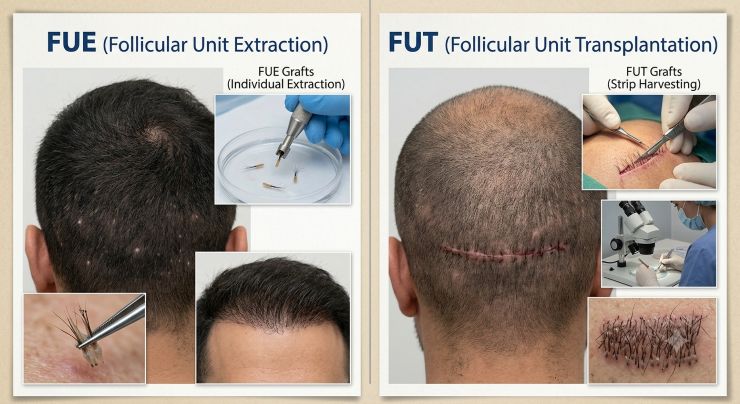
The destination is the same for both. Hair grafts are placed into thinning or bald areas of the scalp. What differs is how those grafts are collected from the donor area.
| FUE | FUT | |
| Full name | Follicular Unit Extraction | Follicular Unit Transplantation |
| How grafts are collected | Individual follicles extracted one by one | A strip of scalp is surgically removed |
| Stitches required | No | Yes |
| Session length | One long session or multiple shorter ones | Typically one session |
| Scar type | Small dot-pattern scars | Single linear scar |
| Recovery period | Usually under 7 days | Approximately 2 weeks |
Both methods use hair from the same donor zone, typically the back and sides of the scalp, where hair is genetically more resistant to thinning.
Scarring: What Each Method Leaves Behind
This is one of the most searched concerns and a completely valid one.
FUT:
- Leaves a single linear scar horizontally across the back of the head
- The scar is permanent but can be concealed with hair of moderate length
- Visible with very short or shaved hairstyles
FUE:
- Leaves multiple small, circular marks scattered across the donor area
- These are significantly less visible, even at shorter hair lengths
- Better suited for patients who prefer to keep their hair short
Neither method is completely scar-free. The difference lies in the type and visibility of the scar and how much that matters depends on each patient's lifestyle and preferences.
Recovery: What the Timeline Actually Looks Like
Here is what recovery practically involves for each method:
| Timeframe | FUE Recovery | FUT Recovery |
| Day 1 to 3 | Mild swelling, small scabs forming at extraction sites | Discomfort at the strip incision site, dressing in place |
| Day 4 to 7 | Scabs begin to shed, most patients resume light activity | Stitches still in place, limited movement advised |
| Week 2 | Near-normal routine for most patients | Stitches removed, gradual return to activity begins |
| Week 3 to 4 | Return to exercise and outdoor activity | More comfortable movement, healing progressing |
Recovery timelines vary between individuals. Age, overall health, graft count, and how well aftercare instructions are followed all influence how quickly the scalp heals. These are general guidelines and not guarantees.
Donor Area: Does Your Scalp Qualify?
Not every patient is automatically suitable for both methods. The donor area plays a major role in determining which technique is clinically appropriate.
- Both FUE and FUT draw from the same donor zone, the back and sides of the scalp
- FUT can harvest a larger number of grafts in a single session, as an entire strip is removed and then divided into individual units
- FUE requires that follicles be spread adequately across the donor area for individual extraction, so patients with lower donor density may not qualify
- A Fox Test is performed to assess whether the scalp is suitable for FUE; not every patient passes this test
This assessment is a standard part of any pre-surgical consultation at a qualified hair transplant clinic in Kolkata. It guides which method is appropriate for that individual and nothing more, nothing less.
Cost of Hair Transplant in Kolkata: FUE vs FUT
Cost is a practical consideration and one that deserves transparency.
- FUE is generally priced higher per session due to the precision involved and the time it takes to extract grafts individually
- FUT can provide a higher graft yield per session at a relatively lower cost per graft
- The price of hair transplant in Kolkata varies based on graft count, technique used, and the experience of the surgeon
As a general reference:
| Method | Approximate Cost Range in Kolkata |
| FUE | ₹40,000 to ₹1,50,000 or more depending on graft count |
| FUT | ₹30,000 to ₹1,00,000 or more depending on graft count |
These are indicative ranges only. Actual cost is determined after a clinical assessment establishes how many grafts are needed. Technique suitability should always come before cost as the primary deciding factor.
Long-Term Results: What to Realistically Expect
Both FUE and FUT use donor hair that is genetically resistant to the hormonal changes that cause thinning, which means transplanted hair, once established, tends to be long-lasting.
What patients can generally expect:
- Transplanted hair sheds in the first few weeks, this is a normal part of the process
- New growth can be noticed around three to four months
- Full results are generally visible between nine and twelve months
- Transplanted hair grows, can be cut, and styled like natural hair
- Non-transplanted surrounding hair may continue to thin over time, this is important to factor into long-term planning
Results vary between individuals depending on age, extent of hair loss, scalp health, and aftercare. No surgical outcome can be guaranteed.
Make Informed Decisions With Clarity
FUE and FUT are not competing methods, they are two clinically valid approaches, each with its own advantages and considerations. One is not universally better than the other.
What makes the difference is how well the chosen method matches the patient's scalp, lifestyle, and expectations. That match can only be determined through a proper clinical evaluation and not through online research alone.
Every patient who walks in with this question deserves a thorough, unhurried assessment, one where the method recommended is based on what the scalp actually needs, not what is quickest or most convenient.
Author:
Dr. V S Rathore
M.B.B.S. (Hons) MS, M. Ch
Plastic, Cosmetic & Reconstructive Surgeon
Frequently Asked Questions
Q1. What is the main difference between FUE and FUT hair transplant?
FUE extracts individual hair follicles one by one from the donor area. FUT removes a strip of scalp and divides it into grafts. Both place grafts into thinning areas, the difference is in how donor hair is harvested.
Q2. Which method leaves less visible scarring?
FUE leaves small, scattered dot-pattern marks that are less noticeable at shorter hair lengths. FUT leaves a single linear scar that can be concealed with moderate hair length. Neither method is completely scar-free.
Q3. How long is recovery for FUE compared to FUT?
FUE recovery is typically under seven days with no stitches required. FUT recovery takes approximately two weeks, with stitches removed at the end of that period. Individual recovery timelines vary based on health, graft count, and aftercare.
Q4. Is FUE more expensive than FUT in Kolkata?
Generally yes. FUE requires more time and precision per session, which reflects in the cost of hair transplant in Kolkata. FUT can provide more grafts per session at a relatively lower cost. Final pricing depends on individual graft requirements.
Q5. Can a patient choose between FUE and FUT themselves?
Patients can express a preference, but the final recommendation is based on clinical assessment. Donor density, scalp condition, extent of hair loss, and a Fox Test result all determine which method is medically appropriate for each individual.
Disclaimer: This content is for general educational purposes only and does not constitute medical advice. Individual results may vary. Please consult your treating doctor for a personalised assessment before starting any treatment.