Going Bald at 25: Is The Cortisol-Hair Loss Connection Wrecking Your Hairline?
You wake up, run your fingers through your hair, and a few strands come with it. Again.
You check the mirror. The hairline looks a little further back than last month. You are 25. This was not supposed to happen yet.
What most people do not realise is that stress is not just exhausting you mentally. It may actually be changing your scalp, your follicles, and your hairline. Silently. Gradually. And for many young men today, it is happening faster than ever.
This blog is not here to alarm you. It is here to explain what is actually going on, so you feel informed, not helpless.
What Is Cortisol, and Why Does It Matter for Hair?
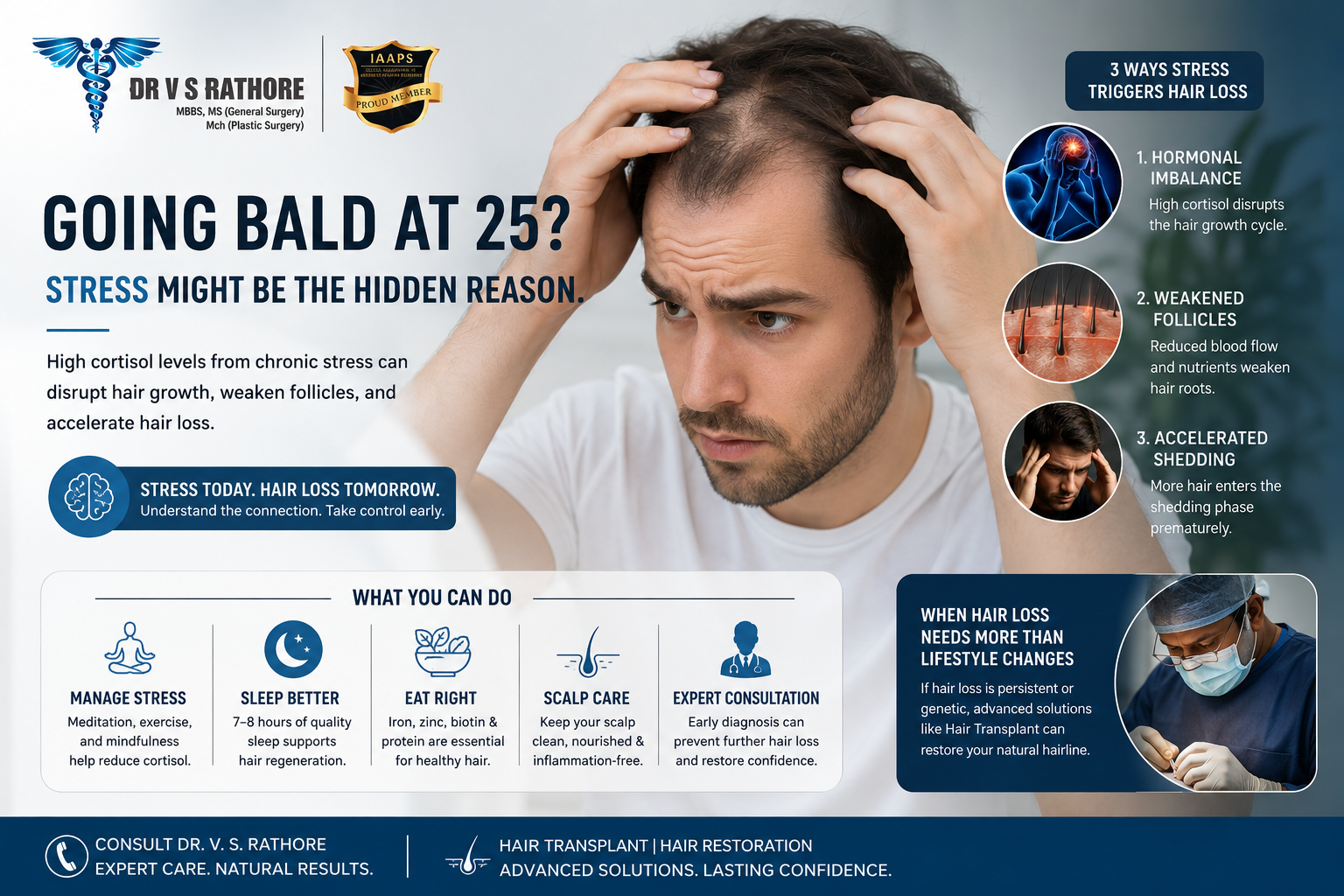
Cortisol is your body's primary stress hormone. When you face pressure - a deadline, a fight, a sleepless night, chronic anxiety that is when your body releases cortisol to help you cope.
That is completely normal. The problem begins when cortisol stays elevated for too long.
When stress becomes a constant background noise in your life, high cortisol levels can:
- Disrupt the natural growth cycle of hair follicles
- Push hair from the active growth phase into a resting or shedding phase
- Reduce blood supply to the scalp
- Interfere with the nutrients hair follicles need to stay healthy
- Trigger inflammation around follicles, weakening them over time
The result? Hair that sheds more than it grows back. And over months, a receding or thinning hairline.
Why Is This Happening to Men in Their 20s?
A generation ago, significant hair loss before 30 was uncommon. Today, it is increasingly normal — and stress is a major reason why.
Young men today face a unique combination of stressors:
- Academic and career pressure starting in teenage years
- Poor sleep cycles due to screens and late-night routines
- Irregular eating habits and nutritional gaps
- Sedentary lifestyles despite physical age
- Social comparison and performance anxiety
- Underlying anxiety or mental health struggles that often go unaddressed
When these pile up over years, the body pays a price. And for many, the scalp shows it first.
Three Ways Stress Triggers Hair Loss
Not all stress-related hair loss looks the same. There are three main patterns worth knowing:
Telogen Effluvium
- Sudden or prolonged stress pushes a large number of follicles into the resting phase simultaneously
- Hair sheds heavily, often 2 to 3 months after the stressful event
- Usually temporary if the root cause is addressed
Alopecia Areata
- An immune response triggered by chronic stress attacks hair follicles
- Shows up as patchy, sudden hair loss in round or irregular shapes
- Can affect the scalp, beard, or eyebrows
Androgenetic Alopecia Accelerated by Stress
- If you have a genetic predisposition to male pattern baldness, chronic stress can speed it up significantly
- Cortisol can raise DHT (dihydrotestosterone) sensitivity, which is the hormone responsible for shrinking follicles in genetically vulnerable men
- This type is progressive and usually requires medical attention
Signs Your Hair Loss May Be Stress-Related
It can be hard to tell the difference between stress-related shedding and genetic hair loss. Here are some signals that cortisol may be a contributing factor:
- Hair loss started or worsened during a particularly stressful period
- You are losing hair from the top and the temples simultaneously at a young age
- You notice more shedding during or after prolonged stress rather than gradually over years
- You are also experiencing fatigue, poor sleep, brain fog, or mood changes
- Hair on other parts of the body is also thinning
None of these are a diagnosis on their own, but if several of these ring true, the connection is worth taking seriously.
Can You Reverse Stress-Related Hair Loss?
Yes, in many cases, particularly early on.
If the loss is primarily cortisol-driven and the follicles are not yet permanently damaged, meaningful recovery is possible with the right approach:
- Manage the stress source - therapy, mindfulness, structured rest, or simply reducing overload where possible
- Improve sleep quality - hair follicles repair and regenerate during deep sleep
- Address nutritional deficiencies - iron, zinc, biotin, and Vitamin D are commonly low in people experiencing hair loss
- Reduce scalp inflammation - avoid harsh shampoos, heat, or chemical treatments during this period
- Consult a specialist - early medical intervention (topical or oral treatments) can stop progression before it becomes permanent
The earlier you act, the more options remain available.
When Hair Loss Goes Beyond Stress
If the hairline has been receding steadily for over a year, if the crown is visibly thinner, or if the loss feels permanent rather than episodic - genetics and DHT are likely involved alongside or instead of cortisol.
In these cases, lifestyle changes alone may not be enough to restore what has already been lost.
This is where hair restoration becomes a genuine, medically sound option. A consultation with a qualified hair transplant surgeon in Kolkata can help you understand exactly where you stand and what your realistic options are, without pressure.
Many men in their mid-20s to early 30s now explore hair transplant in Kolkata after trying and exhausting non-surgical routes. It is no longer a last resort. For the right candidate, it is simply the most effective path back to a natural hairline.
It Is Okay to Not Be Okay About This
Hair loss at 25 is real, it is more common than people admit, and it is okay to feel unsettled by it. But it is also not the end of the road. Understanding the cortisol connection is the first step, because once you know what is happening, you can actually do something about it.
You are not alone in this, and you have more options than you think.
Frequently Asked Questions
Q. Can stress alone cause permanent baldness?
Stress-related hair loss is often reversible if caught early. However, if chronic stress accelerates genetic hair loss (androgenetic alopecia), the follicle damage can become permanent over time. Early evaluation matters.
Q. How do I know if my hair loss is from stress or genetics?
Stress-related loss often correlates with a specific high-stress period and may slow down once the stressor resolves. Genetic loss follows a predictable pattern - receding temples, thinning the crown, regardless of stress levels. A specialist can determine this with a scalp assessment.
Q. At 25, am I too young for a hair transplant?
It depends on the stability of your hair loss. Most specialists prefer to wait until the pattern has stabilised before performing a transplant, to avoid future patchiness. A consultation will give you a clearer picture. The best hair transplant in Kolkata involves proper candidate evaluation first.
Q. Will reducing stress actually regrow my hair?
If the loss is primarily stress-triggered and follicles are still alive, yes, reduced cortisol levels can allow follicles to re-enter the growth phase. Results take 3 to 6 months to become visible. But if the follicles are dormant or dead, stress management alone will not be enough.
Q. What should I do first - see a dermatologist or a hair transplant surgeon?
Start with a consultation at a reputable hair transplant clinic in Kolkata. A good specialist will assess the cause, stage the loss, discuss non-surgical options first, and only recommend a transplant if it is genuinely the right choice for your situation. You should never feel rushed into a procedure.